Akmatori vs Keep: Alert Management Platform or Investigation Agent?
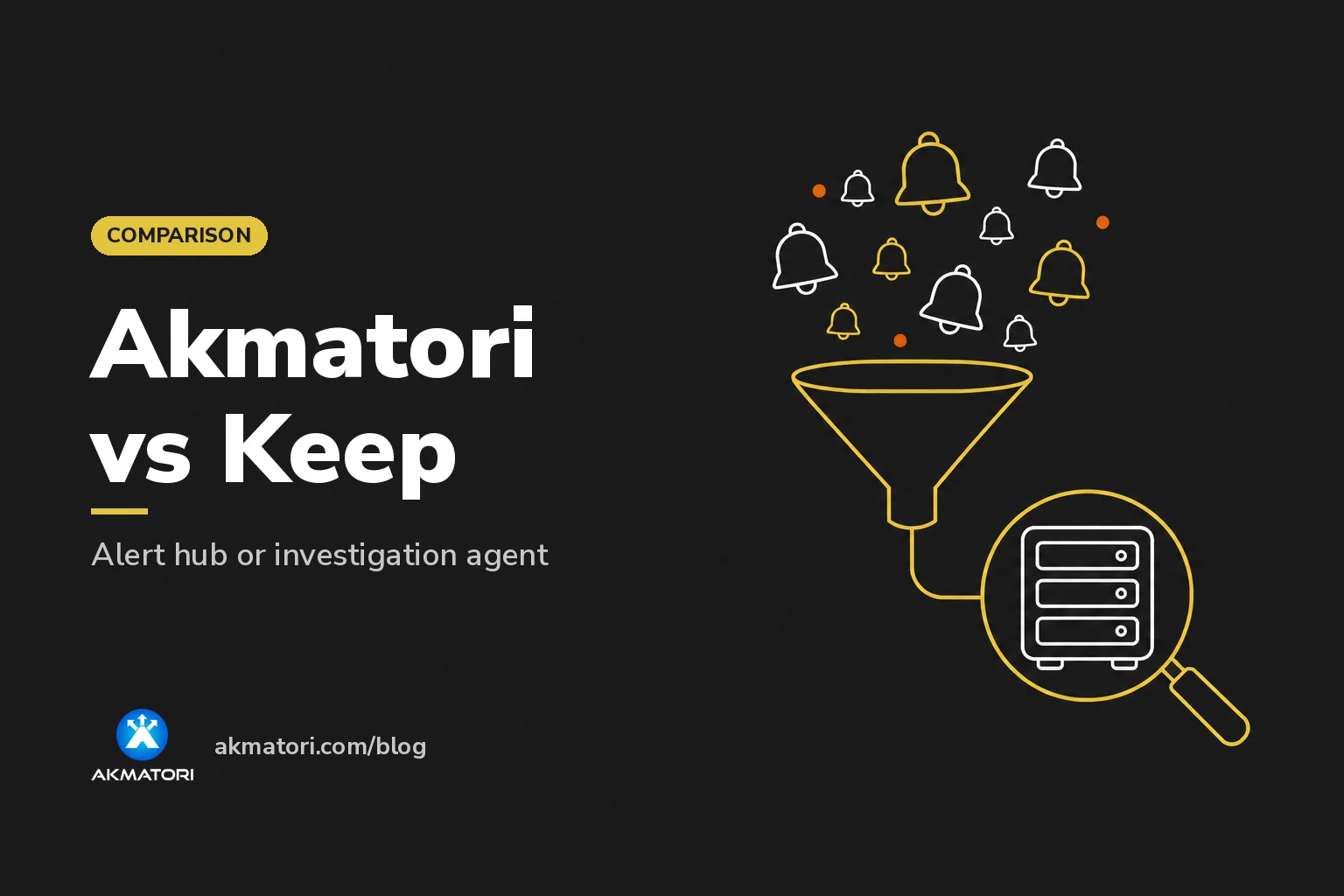
Keep and Akmatori both appear in searches for "open-source AIOps", and both take alerts from Alertmanager, Grafana, PagerDuty, Datadog and Zabbix. They do different jobs. Keep is an alert management platform: it collects alerts from everywhere, deduplicates and correlates them, enriches them, and runs workflows. Akmatori is an investigation agent: it takes an alert and finds out why it fired by querying your systems with an LLM.
We build Akmatori. Keep facts below come from the Keep repository, its documentation and its pricing page as of November 2026.
At a Glance
| Keep | Akmatori | |
|---|---|---|
| Main job | Single pane for alerts: dedup, correlation, enrichment, workflows | Root-cause investigation of each alert by an AI agent |
| License | MIT, with an ee/ directory under a separate license |
Apache-2.0 |
| Owner | Elastic (acquired May 2025) | Akmatori team, powered by Gcore |
| Community | About 12.5k GitHub stars | Young project, first release in May 2026 |
| Deployment | Self-hosted (Helm, Docker Compose), Keep Cloud, managed Enterprise | Self-hosted (Docker Compose) |
| Alert sources | About 120 providers | Alertmanager, Grafana, PagerDuty, Datadog, Zabbix, Slack channels |
| AI correlation | Cloud and Enterprise only (Keep-hosted model) | LLM correlation of new alerts into open incidents, in the open-source build |
| AI investigation | AI incident assistant, experimental in open source | Core feature: agent queries metrics, logs, Kubernetes, hosts |
| Models | OpenAI, Anthropic, Gemini, DeepSeek, Grok, Ollama, llama.cpp, vLLM | OpenAI, Anthropic, Google, OpenRouter, NVIDIA NIM, MiniMax, any OpenAI-compatible endpoint |
| Automation | YAML workflows that call provider actions | Agent skills and cron jobs; risky actions need approval |
| Pricing | Free tier, Growth $199/month, Enterprise custom | Free; you pay for your model usage |
Where Keep Is Stronger
Breadth of alert sources. About 120 providers is far more than any investigation agent connects to. If your first problem is "alerts live in eight tools and nobody sees all of them", Keep solves that problem directly.
Noise reduction and workflows. Deduplication, correlation, enrichment and YAML workflows are Keep's core. It is mature at turning a flood of alerts into a short list of incidents and running deterministic actions on them.
Community and backing. Keep has the largest community of the open-source tools in this space, and Elastic said at the acquisition that Keep will remain open source. If you already use Elasticsearch and Kibana, that connection may matter to you.
Where Akmatori Is Stronger
It answers "why", not only "what". Keep tells you that twelve alerts are one incident. Akmatori then opens that incident's metrics, pod logs, Kubernetes events and host state, compares them with your runbooks and with past incidents, and writes the likely root cause with the evidence. That investigation is the core of Akmatori, not an experimental assistant.
AI features in the open-source build. Keep's AI correlation uses a Keep-hosted model and is available only in Cloud and Enterprise. In Akmatori, LLM correlation and investigation run in the free self-hosted build with your own model.
Safe access to infrastructure. The agent reaches hosts through read-only SSH by default, and actions that change state become proposals a human approves in the UI or in Slack.
Measured quality. We publish SRE Bench: 12 real incidents, a fresh Akmatori install per model, and the root-cause accuracy and cost of each model.
Use Them Together
These tools do not exclude each other. A common split:
- Keep collects alerts from every source, removes duplicates and groups them.
- The alerts that need a human, typically critical ones, also go to Akmatori.
- Akmatori investigates each one and posts the root cause to Slack before the on-call engineer starts.
If you have fewer sources, such as Prometheus, Grafana and Zabbix, Akmatori's own intake and correlation may be enough, and you can send alerts to it directly. See the guides for Alertmanager and Zabbix.
How to Choose
Choose Keep if your main pain is alert noise and scattered sources, you want deterministic workflows, or you are building around the Elastic stack.
Choose Akmatori if your alerts are already routed and your main pain is the time from page to diagnosis, and you want an agent that investigates on your own infrastructure with your own model.
Choose both if you have both problems.
Conclusion
Keep organizes alerts. Akmatori explains them. They overlap on intake and correlation, but their core jobs are different, and many teams will get the most from running Keep in front of an investigation agent. To see what an Akmatori investigation looks like, watch the 3-minute demo or read the getting started guide.
If your team wants AI-assisted incident workflows on your own infrastructure, Akmatori helps SRE teams investigate alerts, coordinate response, and automate safe infrastructure actions. Powered by Gcore for global infrastructure reliability.