
PostHog and Sentry Seer: What to Hand Vendor AI, and How to Keep One Escalation Path
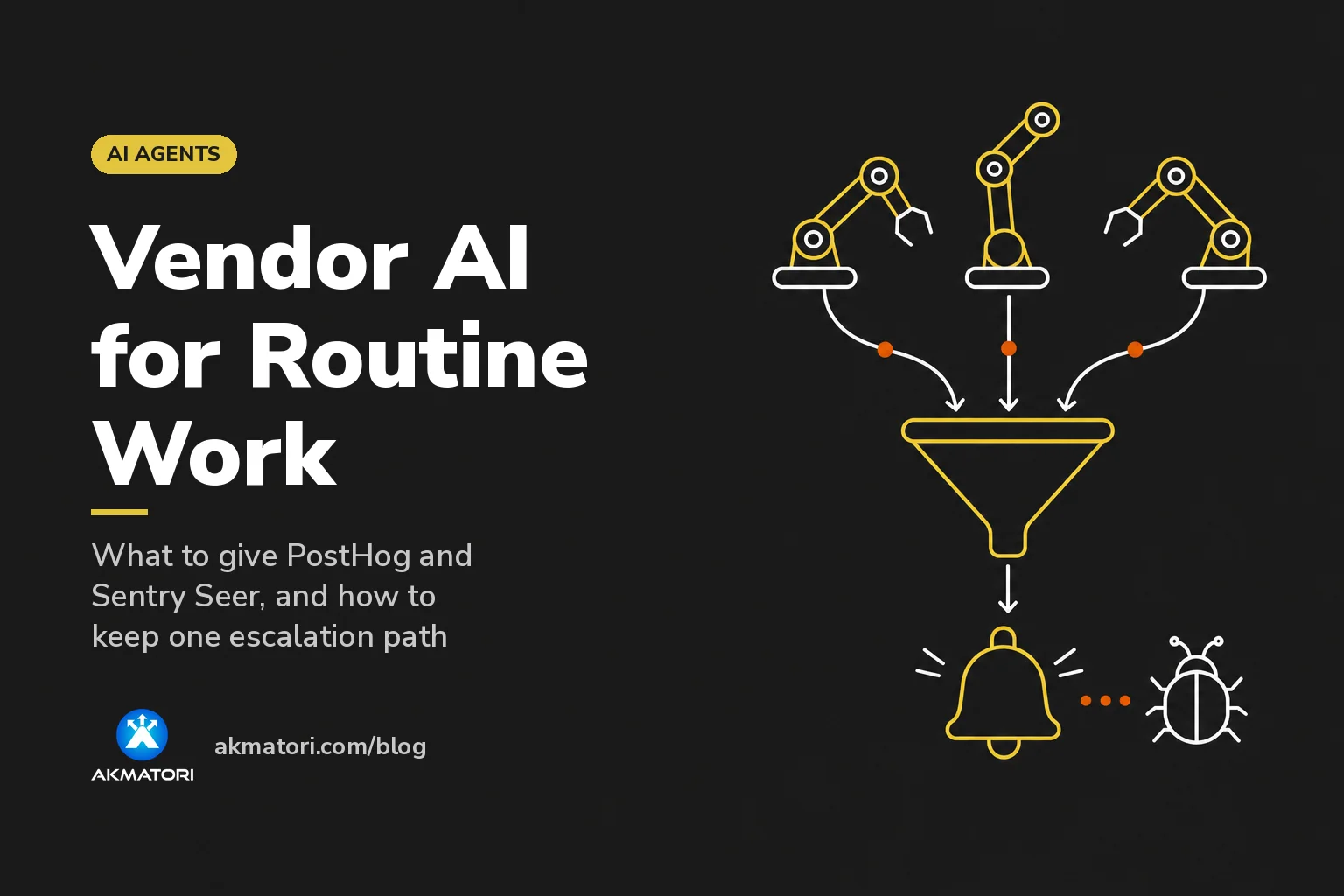
A common stack for small product teams now looks like this. The product analytics tool has an agent that turns user signals into pull requests. The error tracker has an agent that finds root causes and drafts fixes. A general coding agent takes the large features. And a label on a ticket sends it to that coding agent without a human picking it up first.
Each piece works. The trouble starts when one bug wakes all three, and nobody owns the result. This post covers what PostHog and Sentry ship today, which routine tasks are safe to give them, and how to keep a single escalation path instead of a pile of bots that each open their own pull request.
One naming note first: PostHog's docs call the feature self-driving, and they are clear that it is not an autopilot: "Nothing ships without you."
What PostHog Self-Driving Does
PostHog describes self-driving as using "your product data as context to proactively improve your product." It reads signals from error tracking, session replay and health checks inside PostHog, plus external sources such as Jira, Zendesk, GitHub Issues and Linear. It clusters them into prioritized reports.
Two outcomes matter for operators:
- Clear fixes become pull requests. For an actionable report, "PostHog opens a pull request for you to review and merge". A human still merges.
- Judgment calls do not. Reports that need judgment "land in your inbox marked needs input instead of becoming a pull request."
The pricing page adds two facts that change how you run it. "Pull requests are optional and off by default." And when you hit a billing or report limit, "new signals from your sources are dropped." They are not queued.
What Sentry Seer Does
Seer is "Sentry's AI debugging agent." Its Autofix flow runs root cause analysis, plans a solution, generates code, and can then iterate on its own pull request from CI failures.
Autofix can run automatically when automation is on and the issue has "10 or more events," "occurred within the last 14 days," and has "a sufficient fixability score." Each project sets a stopping point: "Stop after Root Cause," "Stop after Plan," or "Stop after PR Drafted." At the code step, Seer can hand off to Claude Code, Cursor Cloud Agents or GitHub Copilot, but "Coding agent handoff only works with GitHub."
Two dates to note: on December 8, 2026, "Seer moves from active-contributor pricing to usage-based credits," and "Seer Code Review is deprecated and will be removed on December 8, 2026." If you planned Seer as your review bot, plan again.
The Ticket-to-Agent Route
The label route is the easiest of the three to build. Anthropic's claude-code-action listens for @claude by default, and its usage docs list a label_trigger input: "The label name that triggers the action when applied to an issue". It has no default, so set it to claude, and a support escalation that becomes a GitHub issue with that label starts an agent run.
It is also the riskiest route, because support tickets carry customer text. The action's security notes say it "can only be triggered by users with write access to the repository." The opt-out, allowed_non_write_users, is marked "RISKY" and "should only be used for workflows with extremely limited permissions." Keep the write-access check. Let a human or a trusted bridge apply the label, and treat the ticket body as untrusted input to the prompt.
Decision Table: What to Hand to Vendor AI
The rule from our post on which tasks to give an AI agent applies here: delegate when something other than you decides "done".
| Routine task | Good owner | Oracle | Stopping point |
|---|---|---|---|
| Null check or bad type in a stack trace | Seer | Reproducing event, CI | PR drafted, human merges |
| Error spike after a deploy | Seer | Release tag, event count | Root cause only; a human chooses revert or fix |
| UI bug many users hit in session replay | PostHog | Replay, before and after metric | PR, human merges |
| "Users are confused by onboarding" | PostHog report | You | Needs input, no PR |
| Bug reported through support | Coding agent via label | Repro test you write first | Draft PR |
| Large feature or schema migration | Coding agent, human driven | Tests, review | Never automatic |
| Production incident: latency, disk, failover | On-call plus an SRE agent | Metrics and logs | Investigation first, actions gated |
The pattern: vendor AI is strongest where the vendor already holds the evidence. Seer holds the stack trace, PostHog holds the replay. Neither holds your infrastructure, so neither should own an incident.
Failure Mode: One Bug, Three Pull Requests
A worked example. A release breaks checkout for one browser.
- Sentry groups the exception. After ten events, with a sufficient fixability score, it passes the automation filter, and Seer drafts a fix.
- PostHog sees the same errors and a drop in conversions in replay. Its report opens a second pull request.
- A customer writes to support. The ticket is escalated, labelled
claude, and the coding agent opens a third.
Now three branches touch the same file with three different fixes. Reviewers approve whichever comes first. Nobody notices that the release itself should have been rolled back.
A second, quieter failure: credits run out. PostHog drops signals past its limit, and Seer's webhooks report seer.errored with a failure_reason that can be out_of_credits. A quiet inbox can mean a healthy product or an empty wallet.
Checklist: One Escalation Path
- One owner per signal. Seer owns exceptions. PostHog owns product behavior. The coding agent owns tickets with a repro. Switch off overlapping automation, for example PostHog pull requests on error clusters that Sentry already covers.
- One dedupe key. Put the Sentry issue ID in every PR title and ticket. A second PR with the same ID gets closed, not reviewed.
- One queue. Send
seer.pr_created,seer.errored, PostHog report notifications and agent PRs to one channel with one human on triage that week. - Stopping points per risk. Root cause only on services that page on-call. Drafted PRs only where CI is trusted.
- Budget alarms as alerts. Alert on
out_of_creditsand on PostHog limits. A dropped signal is a monitoring gap. - Release first. If an error spike starts at a deploy, the first question is rollback, not patch. No vendor bot asks it for you.
- Labels are permissions. Only people with write access apply the agent label. Ticket text is data, not instructions.
Where Production Incidents Go
Seer and PostHog stop at the application boundary. When the cause is a full disk, a bad node or a broken upstream, the alert comes from your monitoring, and it needs an agent that can look at infrastructure.
That is the job Akmatori does on your own network. Per the architecture docs, an alert from Alertmanager, Zabbix, PagerDuty, Grafana or Datadog arrives as a webhook, and the API server either attaches it to an open incident or creates a new one, then posts it to Slack, Telegram, Discord or Zulip. Attaching to an open incident is the one-escalation-path rule in code: a second alert joins the open incident instead of starting a new one. The root cause is posted in the incident's chat thread. Tool calls go through a gateway that checks the run's allowlist, and SSH hosts are read-only by default, with allowed and denied command patterns per connector (connectors docs). Why those limits belong outside the prompt is in our post on agent blast radius.
Conclusion
PostHog self-driving and Sentry Seer handle routine work well when the evidence lives inside their product and a human still merges. Give Seer the stack traces, PostHog the replays, and the coding agent the tickets with a repro. Then add the part no vendor ships: one owner per signal, one dedupe key, one queue, and budget limits that alert instead of going quiet.
If your team wants AI-assisted incident workflows that keep one escalation path from alert to root cause, Akmatori helps SRE teams investigate alerts, coordinate response, and automate safe infrastructure actions. Powered by Gcore for global infrastructure reliability.