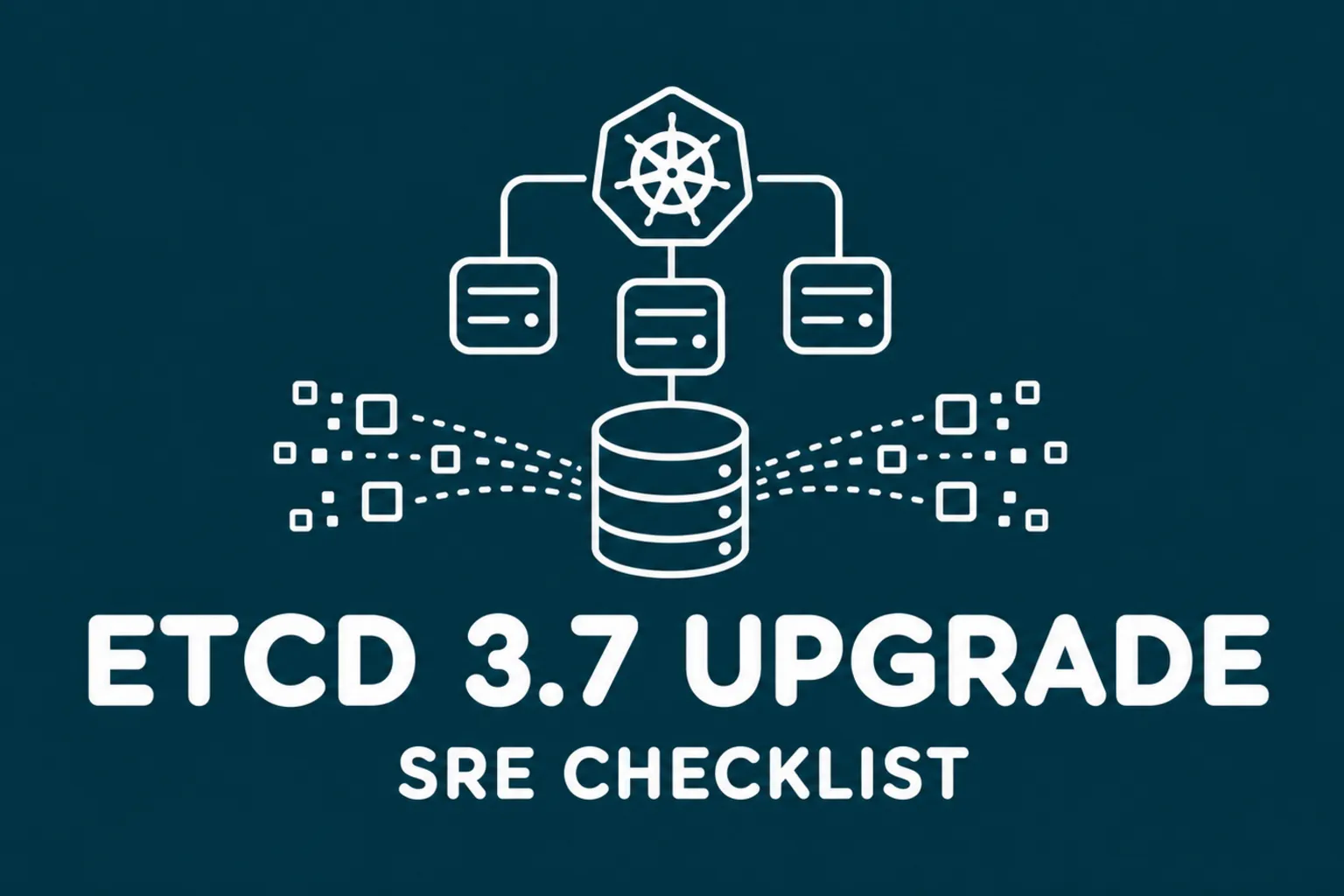
etcd 3.7 Upgrade SRE Checklist
The Kubernetes project mirrored the etcd v3.7.0 announcement this month, and the release is worth attention from platform teams. etcd is not just another dependency. It is where Kubernetes stores cluster state, leases, watches, and the evidence SREs need when the API server starts behaving strangely.
The headline feature is RangeStream, but the bigger operational message is that etcd 3.7 reduces old control-plane debt while changing enough internals to deserve careful rehearsal.
What Changed
RangeStream lets clients receive large range results in chunks instead of waiting for etcd to buffer the entire response. That should make latency and memory usage more predictable for large reads. Kubernetes plans to expose this in the upcoming v1.37 release through the EtcdRangeStream feature gate.
The release also adds a keys-only range optimization, faster lease paths, faster watch matching, optional watch send-loop metrics, and a new etcd_server_request_duration_seconds metric. For busy clusters, those details matter because watch load and lease churn are common sources of control-plane pressure.
etcd 3.7 also completes a major protobuf library cleanup and removes more legacy v2 pieces: v2 discovery, v2 request support, and the v2 client package. If you build tooling against etcd Go modules, read the API notes before you bump dependencies.
Upgrade Checklist
- Read the upgrade guide first: Start with the official etcd 3.7 upgrade documentation and map each warning to your managed Kubernetes or self-managed control-plane model.
- Inventory v2 usage: Search old automation for v2 clients, v2 discovery URLs,
--experimental-*flags, and assumptions about architecture-specific container tags. - Take verified snapshots: Test snapshot restore before the change window. A backup that has never been restored is only a hopeful file.
- Roll one member at a time: Upgrade a single etcd member, wait for cluster health, check leader stability, then continue.
- Watch request and lease latency: Track p99 request duration, proposal latency, fsync latency, lease keepalive failures, and API server watch errors.
- Check Go module consumers: Rebuild internal tools that import etcd packages, especially anything touching protobuf, client creation, or low-level APIs.
Where RangeStream Helps
RangeStream is especially interesting for operators who have seen API server pressure during broad list operations. Large reads can appear during controllers, inventory jobs, backup tooling, and incident scripts that ask for many keys at once.
The practical benefit is not magic throughput. It is bounded memory behavior and earlier delivery of partial results. That makes overload easier to reason about during incidents.
When Kubernetes enables EtcdRangeStream, test it in staging with workloads that resemble real controller and incident-query behavior. Compare etcd member memory, API server latency, watch progress, and client retry patterns before calling it safe.
Operational Notes
Treat etcd as a stateful system with application-facing blast radius. Keep disk latency alarms strict, reserve CPU for members, and avoid noisy neighbors on control-plane nodes. Watch compaction and defragmentation routines after the upgrade, especially if the bbolt file-size limit work changes how your storage policies behave.
The new watch metrics are also worth adding to dashboards before the rollout. A cluster can look healthy at the member level while individual watch paths are falling behind.
Conclusion
etcd 3.7 is a good release for Kubernetes SREs, but it is not a casual patch bump. The right path is simple: inventory legacy usage, verify backups, rehearse the rolling upgrade, and add the new request and watch signals to your control-plane dashboards.
If your team wants AI-assisted incident workflows built on reliable Kubernetes context, Akmatori helps SRE teams investigate alerts, coordinate response, and automate safe infrastructure actions. Powered by Gcore for global infrastructure reliability.