Observability Stack Consolidation
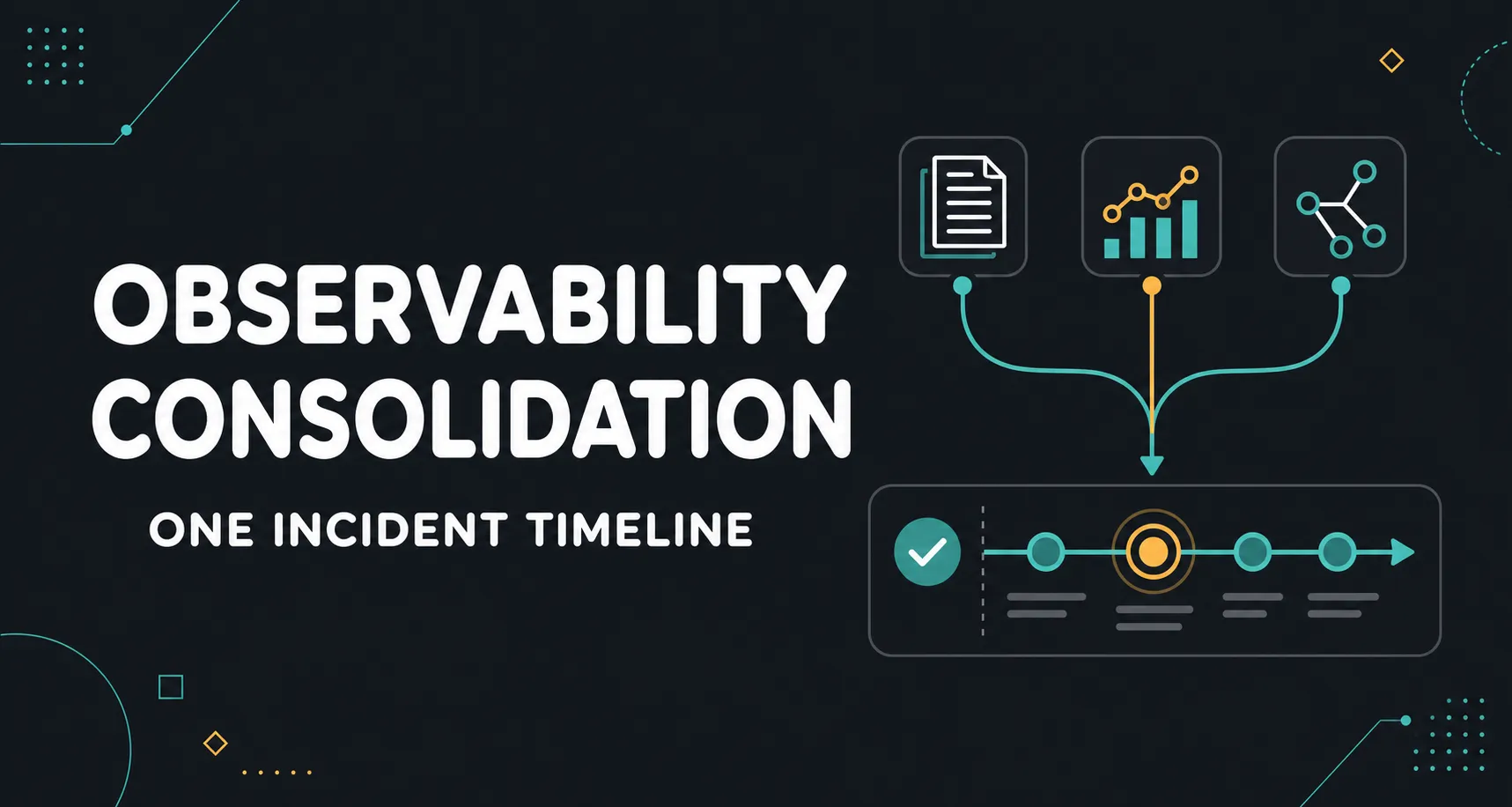
Most production teams do not have an observability problem because they lack data. They have a problem because the data is split across too many tools, dashboards, ownership boundaries, and naming schemes. During an incident, that fragmentation turns into manual correlation work.
A recent CNCF observability survey writeup captured the pattern clearly: many organizations still operate two to three observability tools in parallel, and teams want better integration more than another isolated feature. For SRE teams, that is a roadmap.
What Is Observability Stack Consolidation?
Observability stack consolidation is the work of making telemetry usable as one operational system. It does not always mean replacing every vendor or open-source tool. More often, it means standardizing how services emit signals, how metadata is named, how alerts link to evidence, and how responders move from symptom to cause.
The practical target is simple: when a page fires, the responder should see the relevant metric, logs, trace examples, deploys, ownership, and runbook in one flow. If the team still needs five browser tabs and three query languages before forming a hypothesis, consolidation is not done.
Why SRE Teams Should Care
- Faster triage: Responders spend less time searching for the right dashboard.
- Cleaner alerts: Alert rules can link directly to logs, traces, and recent changes.
- Better AI assistance: Agents need consistent telemetry schemas before they can correlate reliably.
- Lower tool fatigue: Teams can keep specialized backends while presenting a unified workflow.
- More useful reviews: Post-incident analysis improves when the evidence trail is complete.
A Practical Consolidation Path
Start with instrumentation standards before tool migration. OpenTelemetry is usually the best foundation because it gives teams a vendor-neutral way to describe traces, metrics, logs, resources, and service metadata.
service.name
deployment.environment
k8s.namespace.name
k8s.pod.name
cloud.region
http.route
db.system
These fields look boring, but they are what make correlation work. A latency alert can jump to traces only if service names match. A log search can find the right pods only if Kubernetes metadata is present. An incident agent can summarize blast radius only if ownership and environment labels are consistent.
What To Consolidate First
Do not start with a full platform rewrite. Pick one high-value service and build an incident path around it. Wire the alert to the service dashboard, trace examples, recent deploys, logs for the same time window, and the owning team. Then repeat the pattern across critical services.
Next, standardize alert annotations. Every page should include the service, environment, severity, runbook URL, dashboard URL, and a short query hint. This is cheap work with high operational leverage.
Operational Tips
Keep specialized tools where they are genuinely useful. Packet capture, profiling, security telemetry, and cloud billing signals may stay separate. The consolidation layer should help responders discover and correlate those tools, not flatten every workflow into the lowest common denominator.
Measure progress with incident behavior. Track time to first useful hypothesis, number of tools opened, missing labels, broken dashboard links, and how often responders paste screenshots into incident channels because the system cannot link evidence directly.
Conclusion
Observability stack consolidation is not about buying one dashboard. It is about giving SRE teams one trustworthy path from alert to evidence. Standardize telemetry, connect the incident timeline, and make every alert point toward the next useful question.
At Akmatori, we help SRE teams build intelligent automation that responds to incidents and manages infrastructure. For GPU-accelerated AI workloads, check out Gcore cloud infrastructure with global edge locations.