
Kubernetes Volume Group Snapshots Reach GA
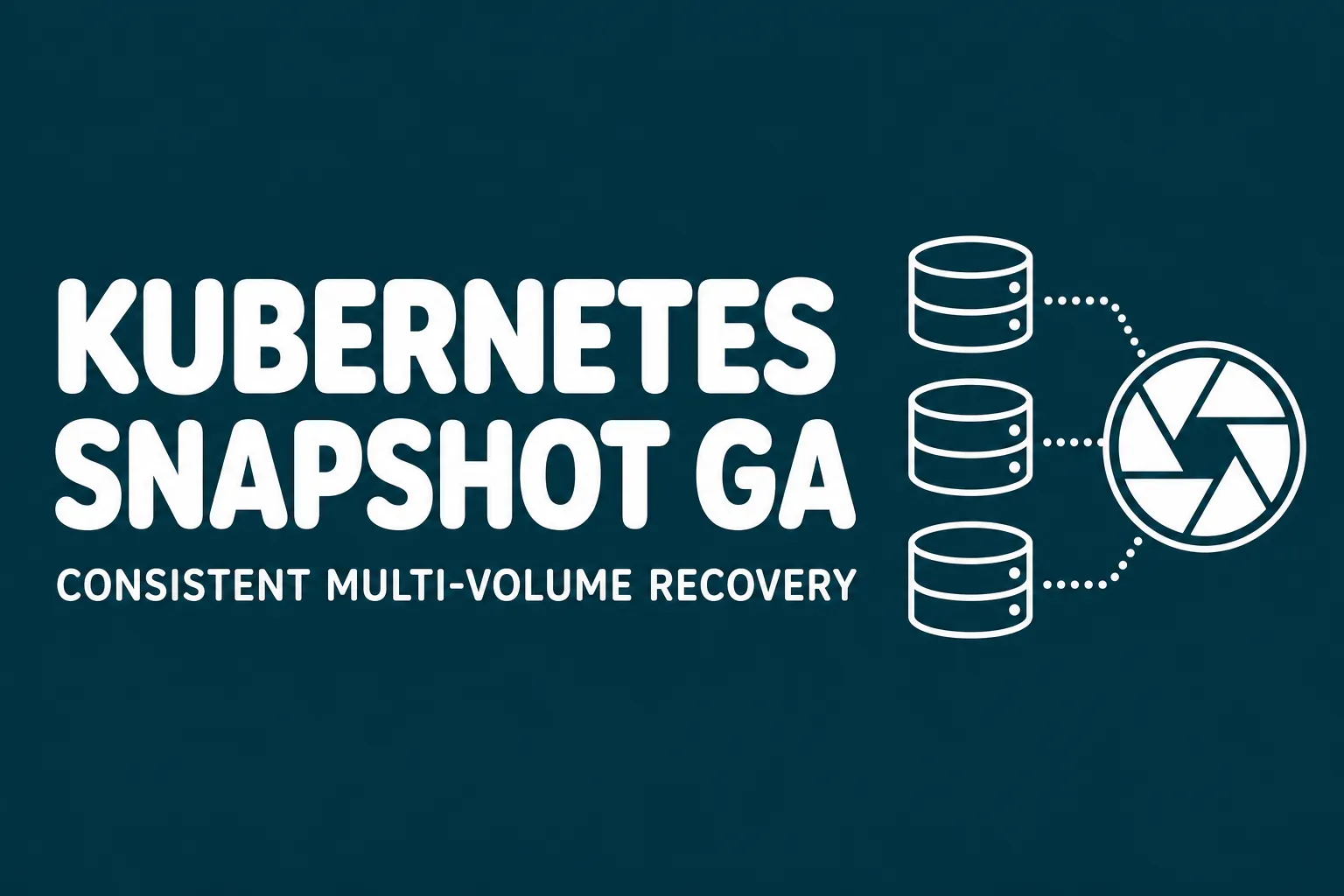
Stateful Kubernetes recovery is rarely about one disk. Real services split data across multiple PersistentVolumeClaims: database files, write-ahead logs, search indexes, queues, and local caches. If each volume is snapshotted at a different time, restore can produce a workload that starts but has inconsistent state.
That is why the Kubernetes v1.36 VolumeGroupSnapshot GA announcement matters for platform teams. It gives operators a stable API for asking CSI storage systems to snapshot a labeled set of PVCs at one point in time.
What Is VolumeGroupSnapshot?
VolumeGroupSnapshot is a Kubernetes API for creating crash-consistent snapshots across multiple volumes. It relies on CSI drivers that implement the group snapshot controller service, so support depends on the storage backend.
The GA release promotes three CRDs to groupsnapshot.storage.k8s.io/v1:
VolumeGroupSnapshotrequests a group snapshot for matching PVCs.VolumeGroupSnapshotContenttracks the provisioned group snapshot resource.VolumeGroupSnapshotClassdefines the CSI driver and deletion policy.
The core idea is simple: label the PVCs that belong to one application state boundary, then create one snapshot request with a selector.
Why SRE Teams Should Care
This closes a long-standing operational gap for multi-volume workloads. Before group snapshots, teams often had to quiesce the application, run sequential snapshots, or accept restore inconsistency. That is fragile during incident response and awkward in automation.
Group snapshots help with:
- Crash-consistent recovery for apps with data and log volumes.
- Repeatable disaster recovery drills using a Kubernetes-native API.
- Less custom scripting around storage-specific snapshot tools.
- Cleaner runbooks because restore points map back to one group snapshot event.
Minimal Workflow
First, label the PVCs that must be captured together:
kubectl label pvc postgres-data group=orders-db
kubectl label pvc postgres-wal group=orders-db
Then create a VolumeGroupSnapshotClass for the CSI driver:
apiVersion: groupsnapshot.storage.k8s.io/v1
kind: VolumeGroupSnapshotClass
metadata:
  name: csi-group-snapshots
driver: example.csi.k8s.io
deletionPolicy: Delete
Finally, request the group snapshot:
apiVersion: groupsnapshot.storage.k8s.io/v1
kind: VolumeGroupSnapshot
metadata:
  name: orders-db-daily-20260524
  namespace: production
spec:
  volumeGroupSnapshotClassName: csi-group-snapshots
  source:
    selector:
      matchLabels:
        group: orders-db
Restore Checklist
Treat the API as a recovery primitive, not a full backup strategy. Before relying on it, verify that your CSI driver supports group snapshots, the external snapshotter components are installed, and your storage class can restore every generated VolumeSnapshot into a new PVC.
Run a restore drill in a non-production namespace. Recreate each PVC from the snapshots in the group, start the workload against the restored volumes, and check application-level consistency. For databases, that still means checking logs, recovery output, replication state, and query correctness.
Also decide who owns the labels. If application teams can change PVC labels freely, snapshot automation can silently miss a volume. Put label ownership into the platform contract or generate it from Helm, Kustomize, or an operator.
Conclusion
VolumeGroupSnapshot GA is a quiet but important Kubernetes storage milestone. It does not replace backups, retention policies, or application-aware recovery testing. It does give SRE teams a stable building block for consistent multi-volume recovery, which is exactly where many stateful incident runbooks used to get messy.
Looking to automate infrastructure operations? Akmatori helps SRE teams reduce toil with AI agents built for real production workflows. For reliable global infrastructure, check out Gcore.