
Headroom for SRE Agent Context
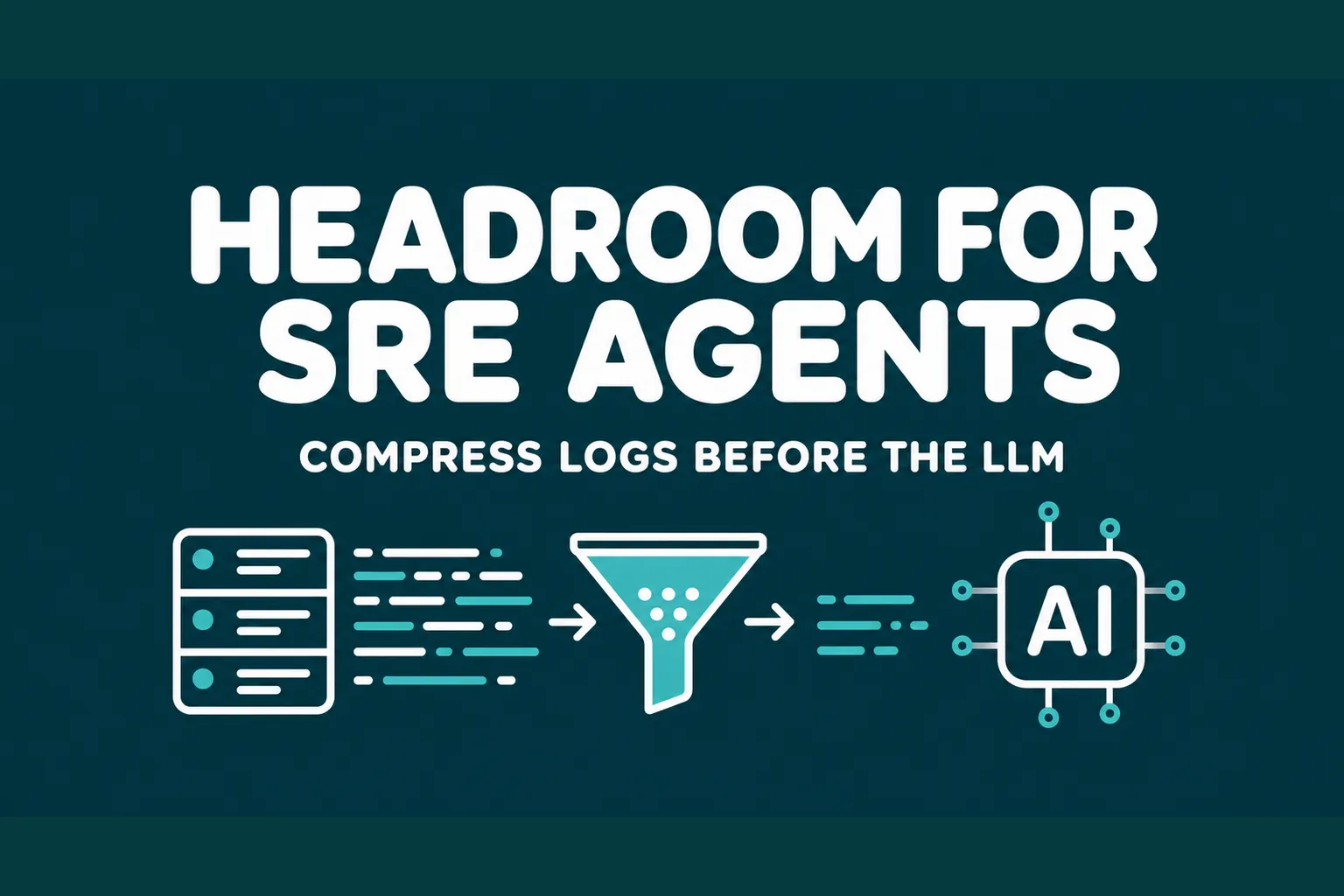
AI incident agents fail in boring ways. They run a log query, receive thousands of lines, paste everything into the model, and lose the useful signal inside a giant prompt. That is expensive, slow, and fragile during on-call work.
Headroom is a context compression layer for AI agents. It can sit in front of tools, logs, RAG results, files, and conversation history, then send a smaller version to the LLM while keeping the original content retrievable locally.
What Is Headroom?
Headroom is an open-source compression layer for agent workloads. It ships as a Python library, TypeScript package, local proxy, agent wrapper, and MCP server. The project describes the goal plainly: compress what the agent reads before it reaches the model.
That matters for SRE teams because incident context is rarely neat. A useful investigation might include Kubernetes events, recent deploys, metrics summaries, traces, config diffs, and several rounds of shell output. Native model compaction helps with chat history, but it does not reshape every noisy tool result before the next model call.
Key Features
- Tool-output compression: shrink logs, files, RAG chunks, and command output before they enter the prompt.
- Local-first processing: run compression locally so raw operational data does not need a separate hosted API.
- Reversible context: keep originals cached through CCR so the agent can retrieve full detail when a compressed view is not enough.
- Multiple integration paths: use
headroom wrap, a local proxy, MCP tools, Python, or TypeScript. - Agent memory support: share compressed context across compatible agents and reduce repeated exploration.
The README reports 60 to 95 percent token reduction across workloads, including an SRE incident debugging example compressed from 65,694 tokens to 5,118 tokens. Treat that as a benchmark to validate in your own environment.
Installation
For a full local install:
pip install "headroom-ai[all]"
For Node or TypeScript integrations:
npm install headroom-ai
You can also run it as a proxy:
headroom proxy --port 8787
Incident Workflow
Wrap a coding or operations agent and point it at a noisy but low-risk investigation:
headroom wrap codex
Then inspect a saved incident bundle, not live production:
kubectl get events -A --sort-by=.lastTimestamp > incident-events.txt
journalctl -u api.service --since "2 hours ago" > api-journal.txt
The agent reads those files through normal tools, while Headroom compresses context before model calls. If it needs exact lines, reversible retrieval can bring back the original source.
Operational Tips
Start with read-only workflows. Good early targets include incident retrospectives, failed CI triage, and log-bundle analysis. Measure answer quality alongside token savings, because compression is only useful if the on-call engineer still gets the right conclusion.
Keep sensitive data policy explicit. Local compression is helpful, but compressed prompts may still contain secrets or production details. Run secret scanning and redaction before agent ingestion when incident bundles leave a trusted environment.
Also pin versions in team workflows. An incident assistant should be reproducible enough that a later postmortem can explain which tools, prompts, and compression settings influenced the recommendation.
Conclusion
Headroom is worth watching because it targets a practical blocker for AI-assisted operations: too much raw context and not enough signal. For SRE teams, the strongest use case is not saving a few cents on prompts. It is making incident agents faster, more focused, and easier to audit.
Akmatori helps SRE teams automate infrastructure operations with AI agents built for real production workflows. For reliable cloud and edge infrastructure, check out Gcore.