
Dapr Verifiable Execution for AI SRE Agents
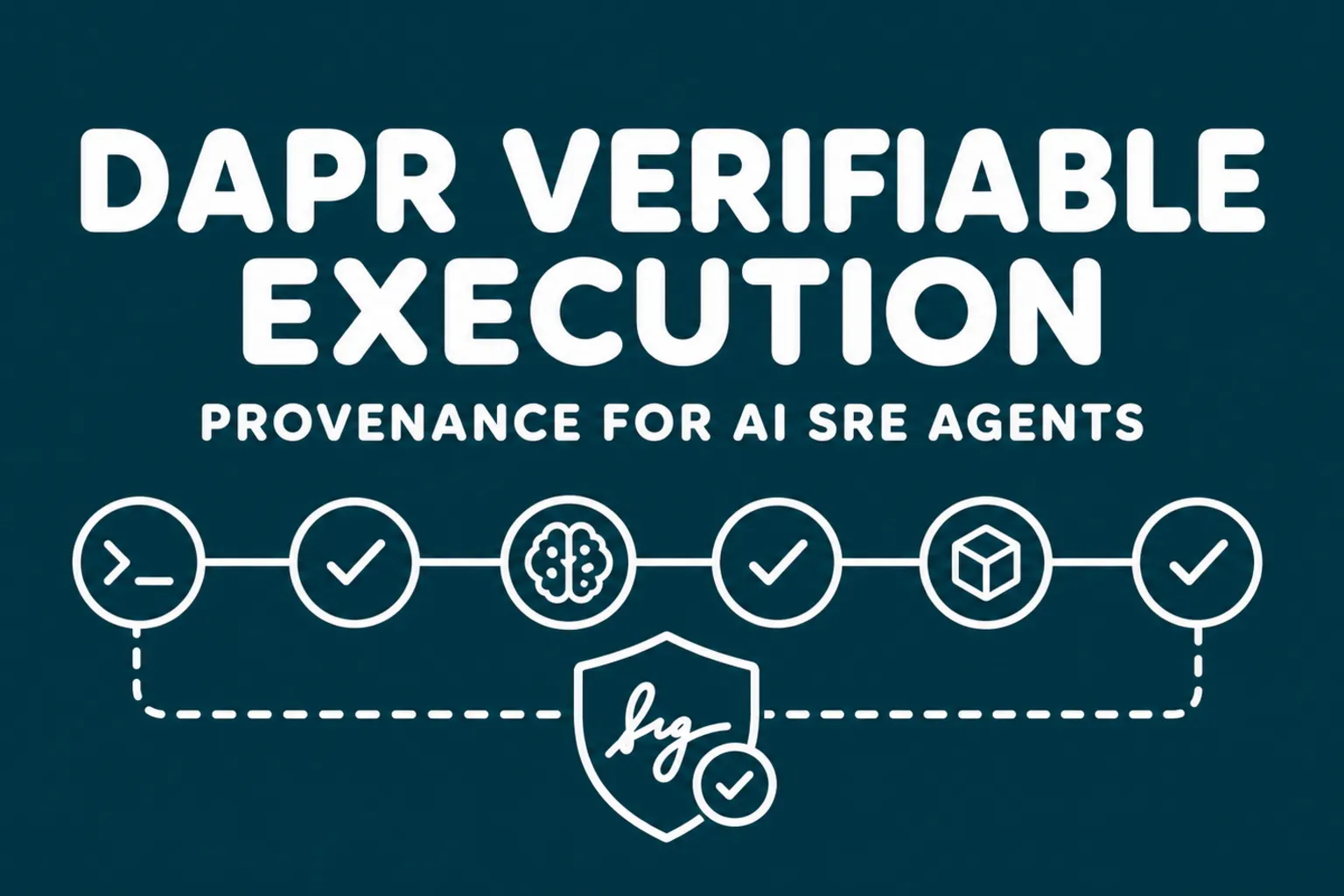
AI agents are starting to trigger real operational workflows: triage an alert, query tools, delegate work, request approval, and suggest remediation. That creates a new reliability question: can downstream systems prove which workflow produced an action and whether the history was changed later?
Dapr is answering that question in version 1.18 with verifiable execution for workflows and agents. The CNCF announcement frames it clearly: observability shows what happened, while verifiable execution helps prove it.
What Is Dapr Verifiable Execution?
Dapr is a distributed application runtime with APIs for service invocation, state, pub/sub, workflow, and agentic AI. Its workflow building block already handles durable, long-running orchestration across services.
Dapr 1.18 extends that model with three related capabilities:
- Workflow History Signing: signs workflow history events using the sidecar X.509 SPIFFE identity when mTLS and the feature flag are enabled
- Workflow History Propagation: lets execution lineage move with calls to child workflows and activities
- Workflow Attestation: gives applications cryptographically verifiable execution context they can use for trust decisions
This matters because logs, traces, and audit records still require trust in the system that stored them. Signed workflow history makes tampering detectable when workflow state is loaded again.
Why SRE Teams Should Care
Agentic operations need stronger controls than chat transcripts. An incident agent might call a Kubernetes tool, ask another workflow for deploy context, and produce a rollback recommendation. In that chain, provenance becomes operational safety data.
With the Dapr model, a platform team can start asking better questions:
- Did this remediation request come from an approved incident workflow?
- Did the workflow pass the required human approval step?
- Which workload identity signed the history?
- Was workflow state modified in the backing state store?
- Can a downstream service reject requests without verified lineage?
That is useful for regulated environments, production change workflows, approval chains, and AI agents that coordinate across multiple tools.
Getting Started
Start with the Dapr workflow docs and test the feature in a non-production namespace:
dapr init
dapr workflow run IncidentTriageWorkflow --app-id sre-agent --input '{"alert":"api-5xx"}'
dapr workflow history <instance-id> --app-id sre-agent
History signing requires Dapr mTLS and the WorkflowHistorySigning feature flag. Once signing is enabled for a workflow, the docs note that it cannot be disabled for that workflow, so treat rollout as a compatibility change.
Operational Tips
Use verifiable execution for narrow, high-value flows first. Good candidates are production rollback approval, change freeze exceptions, credential rotation, and incident remediation where later proof matters.
Keep the trust boundary explicit. Dapr signing and attestation help verify workflow history, but they do not replace policy design. Pair them with workflow access policies, least-privilege tool permissions, and clear human approval points.
Also monitor failure modes. If tampering is detected, Dapr can fail the workflow instead of acting on forged state. That failure should page the right team, preserve the evidence, and block automated remediation until a human reviews it.
Conclusion
Dapr 1.18 is a useful signal for the next phase of AI operations. Durable execution keeps workflows alive through failures. Verifiable execution helps prove how the work happened and whether the chain can be trusted.
If your team is building AI-assisted incident response, Akmatori helps SRE teams connect alerts, tools, context, and controlled automation into production-ready workflows. For reliable global infrastructure, explore Gcore.